
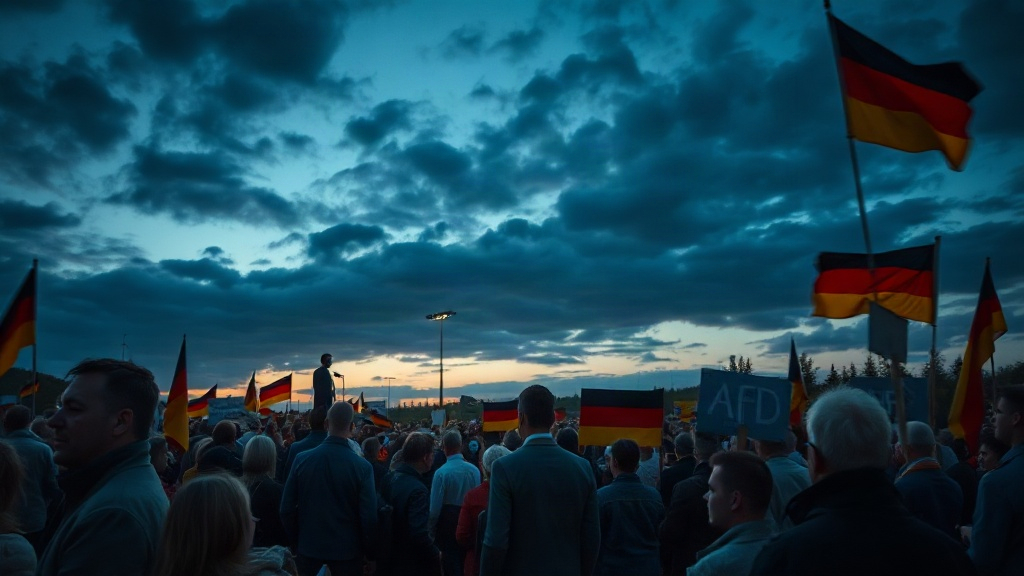
The political ground in Germany shifted once again this week, and the tremors are being felt most acutely in the chancellery. Friedrich Merz, the man who took the helm of Europe's largest economy with promises of stability and renewal, now finds himself at the center of a storm not of his own making, but one that threatens to define his tenure. The far-right Alternative for Germany (AfD) has scored a significant victory in a state election, and the result is more than just a regional blip. It is a stark signal that the political center is struggling to hold, and that Merz's leadership is under a microscope like never before.
For months, political observers have debated whether the AfD's appeal was a temporary protest vote or a deeper, more structural shift in German politics. The latest results suggest the latter. In a state that has long been a bellwether for national sentiment, the AfD did not just perform well; it surged. The party's message, which blends hardline immigration policies with a blistering critique of the establishment, resonated with voters who feel left behind by globalization, frustrated by bureaucratic inertia, and alienated by a political class they see as out of touch.
But what makes this result particularly painful for Merz is that it comes at a time when his own party, the center-right Christian Democratic Union (CDU), is struggling to define its identity. Merz has tried to steer the CDU back to its conservative roots after the centrist era of Angela Merkel, hoping to win back voters who drifted to the AfD. Yet the strategy has not yielded the expected dividends. Instead, the AfD has only grown stronger, and the CDU finds itself squeezed between a resurgent far right and a fragmented left.
The pressure on Merz is now multifaceted. Within his own party, there are murmurs of discontent. Some senior CDU figures question whether his confrontational style and sharp rhetoric are helping or hurting. Others worry that the party's attempts to outflank the AfD on immigration and law-and-order issues have only legitimized the far right's talking points without winning back its voters. The state election result has given those critics new ammunition.
At the same time, Merz must contend with the reality of coalition politics. Germany's federal government is a delicate three-way alliance that has been plagued by infighting and policy gridlock. The AfD's rise makes that coalition even more fragile. The mainstream parties are now forced to consider how to respond to a political force that many of them have vowed to isolate. The so-called firewall against the far right remains in place, but it is under strain. Every election that sees the AfD gain ground makes the firewall look less like a principled stance and more like a desperate dike holding back an inevitable flood.
The implications extend beyond Germany's borders. As the largest economy in the European Union, Germany's political stability is a cornerstone of the bloc's cohesion. A weakened chancellor, a divided coalition, and a surging far-right party do not inspire confidence among European partners or international investors. The AfD's success also emboldens like-minded movements across the continent, from France's National Rally to Italy's Brothers of Italy. The message is clear: the populist right is not fading; it is adapting and growing.
For Merz, the path forward is fraught with difficult choices. He could double down on his conservative credentials, hoping to siphon off AfD support by adopting tougher stances on immigration and crime. But that risks alienating moderate voters and further normalizing the far right's agenda. Alternatively, he could pivot toward the center, attempting to rebuild a broad coalition of democratic forces against extremism. But that would require abandoning some of his core promises and potentially angering his party's right wing. Neither option is without risk.
There is also the question of timing. Merz does not face a national election until 2029, which might seem like a luxury. But in politics, time can be an enemy as much as an ally. If the AfD continues to gain ground in state elections, the pressure will only intensify. A leader who is seen as weak or ineffective can quickly become a liability, even without an immediate electoral test. The next few months will be critical. Merz must demonstrate that he has a strategy to counter the far right's appeal, not just with words but with tangible results on the issues that matter most to voters: the economy, immigration, and public safety.
The state election result is not a death knell for Merz's chancellorship, but it is a wake-up call. The political landscape is shifting, and the old certainties no longer apply. The AfD's rise is not an aberration; it is a symptom of deeper discontents that have been building for years. Merz can either address those discontents head-on or risk being swept aside by them. The choice is his, but the clock is ticking.
Why the AfD's Victory Matters for Germany and Europe
The AfD's strong showing in a state election is not just a domestic story; it has profound implications for the European project. Germany's political stability has long been taken for granted, but the rise of a far-right party with nationalist and Eurosceptic tendencies challenges that assumption. The AfD has been critical of the EU, questioning everything from migration policy to financial solidarity. If the party continues to grow, it could complicate Germany's role as a leader in Brussels and undermine the consensus that has held the bloc together for decades.
For Merz, this is a particularly thorny issue. He has positioned himself as a transatlanticist and a firm supporter of European integration. But he now faces a domestic political landscape where such positions are increasingly contested. The AfD's success gives a platform to voices that would like to see Germany retreat from its international commitments. Merz will have to navigate these crosscurrents carefully, balancing the demands of his own party with the need to maintain Germany's standing on the world stage.
What Comes Next for Merz and the CDU
The coming weeks will be a test of Merz's political skills. He will need to rally his party, reassure his coalition partners, and present a credible plan to address the concerns that are driving voters toward the AfD. That plan will have to go beyond slogans and soundbites. It will require concrete policies on immigration, economic revitalization, and social cohesion. It will also require a willingness to listen to voters who feel ignored by the political establishment.
Merz is not without resources. He remains a formidable political operator with a deep understanding of his party and the levers of power. But the state election has shown that the old playbook may no longer be enough. The AfD has tapped into a wellspring of frustration that cannot be dismissed or wished away. Merz's challenge is to offer an alternative vision that is both credible and appealing, one that addresses the legitimate grievances of voters without resorting to the divisive rhetoric of the far right.
Frequently Asked Questions
What does the AfD's state election win mean for Chancellor Merz?
The win increases pressure on Merz to address the issues driving voters to the far right, such as immigration and economic anxiety. It also raises questions about his leadership within the CDU and the stability of his coalition government.
Why is the AfD gaining support in Germany?
The AfD has capitalized on discontent with mainstream parties, particularly around immigration, crime, and economic stagnation. Its anti-establishment message resonates with voters who feel left behind by globalization and distrustful of traditional politicians.
Could the AfD ever join a national government in Germany?
Currently, all mainstream parties have ruled out forming a coalition with the AfD, maintaining a "firewall" against the far right. However, if the AfD continues to grow, this position may become harder to sustain, especially at the state level where coalitions are more fluid.
How does the AfD's rise affect Germany's role in the European Union?
A stronger AfD could complicate Germany's leadership in the EU, as the party is critical of European integration and advocates for more national sovereignty. This could strain relations with EU partners and undermine collective decision-making.
What can Merz do to counter the AfD's appeal?
Merz could adopt tougher policies on immigration and crime to win back conservative voters, but that risks alienating moderates. Alternatively, he could focus on economic reforms and social cohesion to address the root causes of discontent. The challenge is to find a balance that restores trust in the political center without legitimizing far-right rhetoric.