
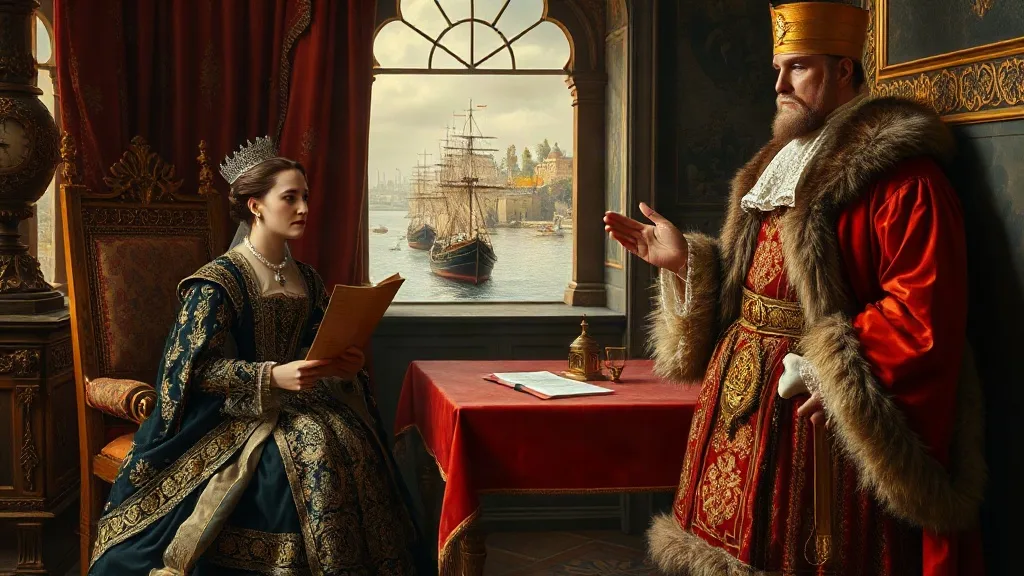
When Ivan the Terrible, the first Tsar of Russia, set his sights on marrying Queen Elizabeth I, he was not merely seeking a bride. He was probing for an alliance that could reshape the balance of power in Europe. Elizabeth, famously the 'Virgin Queen' who never married, had to reject his advances without jeopardizing the profitable trade relationship between England and Russia. A new book sheds light on this delicate diplomatic dance, revealing how Elizabeth's shrewdness and subtlety kept commerce flowing even as she turned down the most powerful man in the East.
The Context: A Tsar in Search of a Queen
Ivan IV, known to history as Ivan the Terrible, ruled Russia from 1547 until his death in 1584. His reign was marked by territorial expansion, centralization of power, and a streak of paranoia and cruelty that earned him his ominous epithet. Yet Ivan was also a man of grand ambitions, eager to elevate Russia's standing among European nations. Marriage to a European princess would have been a diplomatic coup, lending legitimacy to his nascent empire.
Elizabeth I, on the other hand, had ascended to the English throne in 1558 amid religious turmoil and external threats. Her refusal to marry was not merely a personal choice but a political strategy: by remaining unmarried, she preserved her independence and kept suitors dangling, using the prospect of her hand as a bargaining chip in international relations. Her subjects, however, constantly pressured her to marry and produce an heir, a tension that would persist throughout her reign.
The trade connection between England and Russia had been established in 1553, when the English explorer Richard Chancellor reached the northern Russian port of Archangel (now Arkhangelsk) while seeking a northeast passage to China. The Muscovy Company was subsequently granted a monopoly on English trade with Russia, exporting cloth, metals, and weapons in exchange for furs, wax, and timber. This trade was immensely valuable to both sides, and Elizabeth was determined to protect it.
The Proposal: Ivan's Overture
In 1567, Ivan sent a letter to Elizabeth proposing marriage. The offer came with strings attached: Ivan hinted that he expected Elizabeth to share power and perhaps even convert to the Orthodox faith. For Elizabeth, the proposal was fraught with peril. Rejecting a powerful monarch outright could provoke hostility, yet accepting was unthinkable. She had no intention of leaving England, nor of subordinating herself to a foreign ruler.
The new book, whose title and author are not specified in the source summary, details how Elizabeth navigated this tricky situation. She responded with a carefully crafted letter that expressed admiration for Ivan's achievements and affection for his person, but politely declined the marriage on the grounds of her commitment to her country and her reluctance to leave her realm. She also emphasized her desire to maintain the friendship and trade between their nations.
Elizabeth's response was a masterpiece of diplomatic ambiguity. She wrote of her 'great liking' for Ivan's 'virtues and princely qualities' but explained that she could not accept his proposal because she was already 'married' to her kingdom. This metaphor, which she often used, allowed her to decline without directly offending him. She also sent gifts, including a lion and a lioness, to placate the Tsar.
The Aftermath: Trade Prevails
Despite the rejection, Ivan did not break off relations. In fact, he continued to write to Elizabeth, sometimes expressing frustration at her evasiveness. But the trade relationship not only survived but thrived. The Muscovy Company continued to operate, and English merchants gained further privileges in Russia. Elizabeth's ability to separate the personal from the political proved crucial.
Historians have noted that Elizabeth's handling of Ivan's proposal was characteristic of her foreign policy: she used delay, flattery, and ambiguity to avoid conflict while safeguarding English interests. By refusing to marry but maintaining friendly correspondence, she kept the Tsar engaged without making commitments that could drag England into costly entanglements.
The episode also highlights the importance of trade in early modern diplomacy. Elizabeth's refusal to marry Ivan the Terrible did not lead to a rupture because both sides recognized the mutual benefits of commerce. The Tsar needed English goods and expertise, while England needed Russian raw materials for its growing navy and industries. This pragmatic approach to international relations was a hallmark of Elizabeth's reign.
Why This Story Matters Today
In an era when personal and political relationships were often intertwined, Elizabeth's ability to say no without making enemies is a lesson in diplomacy. The new book offers a window into the complexities of early modern statecraft, showing how a female ruler navigated the expectations of her gender and the demands of her position. It also underscores the resilience of trade as a stabilizing force in international affairs.
For contemporary readers, the story of Ivan and Elizabeth resonates beyond historical curiosity. It illustrates how leaders can manage difficult negotiations by focusing on shared interests, even when personal desires clash. Elizabeth's strategy of polite deflection and consistent communication preserved a valuable partnership, a tactic that remains relevant in today's interconnected world.
Frequently Asked Questions
Why did Ivan the Terrible want to marry Elizabeth I?
Ivan sought marriage to Elizabeth to strengthen Russia's international standing and to forge a closer alliance with England, which was a valuable trading partner. A marriage would have elevated his prestige among European monarchs.
How did Elizabeth I reject Ivan's proposal without offending him?
Elizabeth used flattery and diplomatic language, expressing admiration for Ivan while explaining that she could not marry because she was committed to her kingdom. She also sent gifts and maintained friendly correspondence to soften the refusal.
Did the rejection harm trade between England and Russia?
No, trade continued to flourish. The Muscovy Company retained its privileges, and both nations benefited from the exchange of goods. Elizabeth's careful handling ensured that commerce remained unaffected by the personal rejection.
What was the Muscovy Company?
The Muscovy Company was an English trading company established in 1555 to conduct trade with Russia. It held a monopoly on English trade with Russia and was instrumental in developing commercial ties between the two countries.
Was Elizabeth I ever married?
No, Elizabeth I never married, earning her the nickname 'The Virgin Queen.' She used her unmarried status as a diplomatic tool, entertaining marriage proposals but never committing, to maintain her independence and political leverage.