
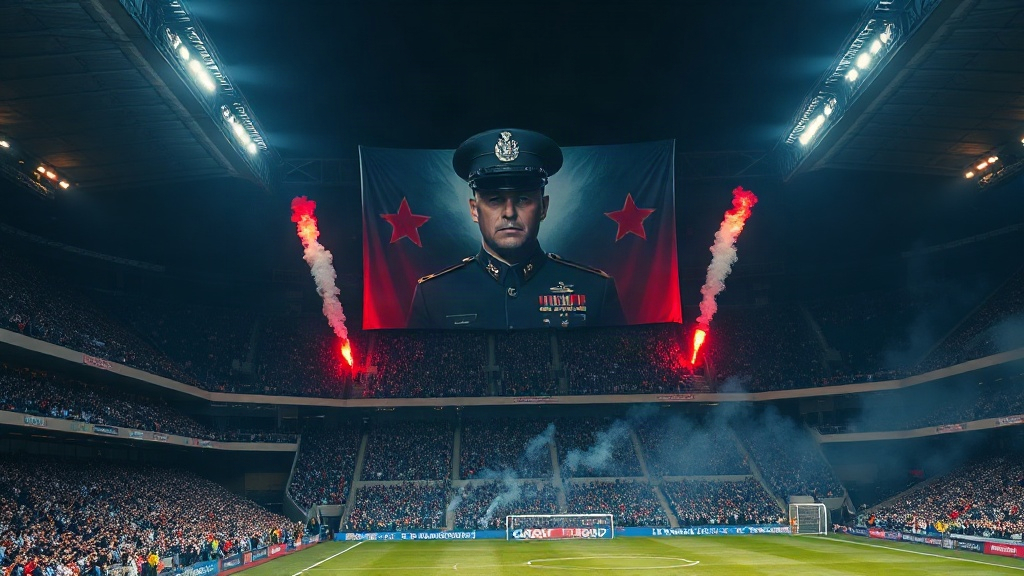
It was supposed to be a celebration of football, but before the latest Eternal Derby between Red Star Belgrade and Partizan, a section of the home crowd turned the spotlight on a dark chapter of Balkan history. Red Star fans unveiled a large banner depicting Ratko Mladic, the former Bosnian Serb military leader convicted of genocide and crimes against humanity. The display came moments before kickoff and was visible to television cameras, sparking immediate condemnation from human rights groups and reigniting a painful debate about how Serbian football grapples with its past.
The Mladic banner at the derby was not an isolated gesture. It followed a pattern of nationalist symbolism that has appeared in Serbian stadiums for years, often tolerated or ignored by club officials and football authorities. Mladic, who led Bosnian Serb forces during the 1992-1995 war, was sentenced to life in prison in 2017 by the International Criminal Tribunal for the former Yugoslavia (ICTY) for his role in the Srebrenica massacre and the siege of Sarajevo. For many in the region, he remains a symbol of ethnic violence and suffering. For some Serbian nationalists, however, he is still hailed as a hero.
What Exactly Happened Before the Derby?
The Eternal Derby, contested between Belgrade's two biggest clubs, is one of the most intense rivalries in European football. Security is always high, and the atmosphere is charged with political undertones. On Sunday, as the teams prepared to take the field at Red Star's Rajko Mitić Stadium, a banner was unfurled in the north stand, where the club's most hardcore supporters, the Delije, are based. The banner featured a portrait of Mladic in military uniform, accompanied by the words "Serbian Hero" in Cyrillic script. It remained in place for several minutes before being removed by stewards, though images had already spread rapidly on social media.
Red Star won the match 2-0, but the result was overshadowed by the pre-game display. The club itself has not issued an official statement as of this writing, and the Serbian Football Association has remained silent. UEFA, which governs European club competitions, has previously sanctioned clubs for political or offensive banners, but the derby falls under domestic jurisdiction, where enforcement is historically lax.
Why Does This Keep Happening?
To understand the recurrence of such displays, one must look at the political landscape in Serbia. Since the end of the Yugoslav wars, nationalist narratives have persisted in parts of the media, education system, and political rhetoric. Mladic, despite his conviction, is still celebrated by some political factions and veteran groups. His image appears on murals, T-shirts, and occasionally in football stadiums. The glorification of war criminals in Serbian football is not a new phenomenon, but each incident draws renewed international attention and criticism.
Football ultras groups in Serbia have long been intertwined with nationalist politics. The Delije and Partizan's Grobari both have factions that embrace extreme nationalist symbols. During the 1990s, some ultras leaders were recruited into paramilitary units, and the legacy of that era persists. The Mladic banner is a symptom of a broader failure to confront the past, according to historians and activists. "When a convicted war criminal is celebrated in a public space, it sends a message that justice and accountability do not matter," said a regional human rights advocate who asked not to be named due to safety concerns.
Reaction from Human Rights Groups and International Community
The Mothers of Srebrenica, an association representing families of the more than 8,000 Bosniak men and boys killed in July 1995, issued a statement calling the banner "a slap in the face to all victims." The organization has repeatedly urged Serbian authorities to ban such displays and prosecute those responsible. International bodies, including the Council of Europe and the OSCE, have also expressed concern about the normalization of war criminal glorification in the Western Balkans.
However, legal consequences remain rare. Serbian law prohibits incitement to ethnic hatred and the promotion of war criminals, but enforcement is inconsistent. In 2021, a mural of Mladic in Belgrade was repeatedly vandalized and repainted, leading to a standoff between activists and nationalist groups. The government eventually allowed the mural to remain, citing "freedom of expression." Critics argue that such tolerance emboldens groups like the Delije to continue their displays without fear of punishment.
What Does This Mean for Serbian Football?
Serbian clubs have faced sanctions from UEFA for racist chants and political banners in European competitions. In 2014, Partizan was fined after fans displayed a banner supporting Russian separatists in Ukraine. Red Star has also been punished for similar offenses. But domestic matches are governed by the Serbian FA, which has a poor record of sanctioning clubs for ultra-nationalist behavior. This creates a double standard: when playing abroad, Serbian clubs are on their best behavior, but at home, the most extreme elements feel free to express themselves.
The Mladic banner before the derby could have consequences for Serbia's international image. The country is a candidate for European Union membership, and such incidents provide ammunition for critics who argue that Serbia has not done enough to distance itself from the legacy of the war. The EU has repeatedly stressed the importance of reconciliation and rule of law in its accession talks. A football banner may seem trivial, but in the context of Balkan politics, symbols carry enormous weight.
Can Anything Be Done?
Experts suggest several measures to curb the glorification of war criminals in stadiums. First, clubs must take proactive steps: banning known offenders, working with fan groups to promote positive messages, and cooperating with police to identify those who display illegal banners. Second, the Serbian FA should enforce its own regulations more strictly, with clear penalties for clubs that fail to control their supporters. Third, political leaders need to publicly condemn such actions, not just when international pressure mounts, but as a matter of principle.
There are signs of hope. Some fan groups in Serbia have rejected nationalist symbols and called for a focus on football rather than politics. Civil society organizations continue to document incidents and pressure authorities to act. But as long as figures like Mladic are celebrated in public spaces, the wounds of the 1990s will remain open.
Frequently Asked Questions
Was anyone arrested for displaying the Mladic banner?
As of now, no arrests have been reported in connection with the banner display. Serbian police typically monitor stadiums but rarely intervene in fan choreography unless it leads to violence. The banner was removed by stewards, but identifying those responsible may be difficult without cooperation from the club.
Has Red Star Belgrade responded to the controversy?
Red Star has not issued an official statement about the incident. The club's silence has drawn criticism from anti-war groups, who argue that a public condemnation would be a minimal step. In the past, Red Star has distanced itself from fan actions only when faced with sanctions from UEFA.
Could Red Star face punishment from UEFA for the banner?
No, because the match was a domestic league fixture, not a UEFA competition. UEFA only has jurisdiction over its own tournaments, such as the Champions League or Europa League. The Serbian Football Association could theoretically sanction Red Star, but such cases are rare and penalties are usually minimal.
Why is Ratko Mladic such a controversial figure?
Ratko Mladic was the commander of the Bosnian Serb army during the Bosnian War. He was convicted by the ICTY of genocide, war crimes, and crimes against humanity, including the Srebrenica massacre and the siege of Sarajevo. He is reviled by many in Bosnia and beyond, but some Serbian nationalists view him as a defender of Serb interests.
What is the significance of the Eternal Derby in Serbian culture?
The Eternal Derby between Red Star and Partizan is more than a football match; it is a reflection of social and political divisions in Belgrade. The rivalry dates back to 1947 and has often been a stage for political expression. The two clubs have different historical roots, and their fan bases have been associated with various political movements over the decades. The derby's intensity makes it a prime venue for ultra-nationalist displays.