
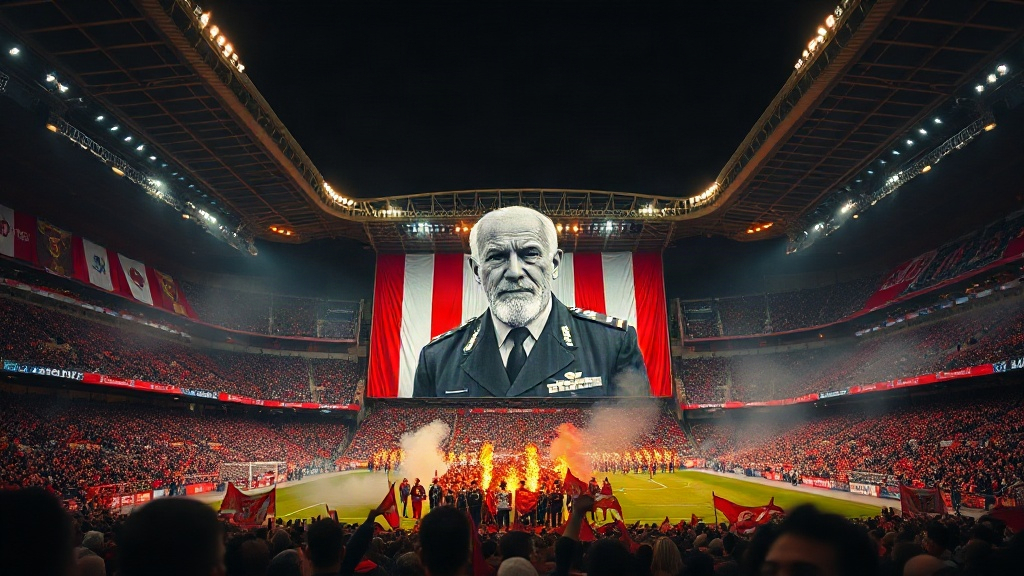
In a move that has drawn sharp criticism both domestically and internationally, Red Star Belgrade supporters unveiled a massive tifo of convicted war criminal Ratko Mladic before Sunday's eternal derby against Partizan. The display, which covered a significant section of the stadium's north stand, featured the former Bosnian Serb military leader's face alongside the words "Serbian hero." The incident occurred just minutes before kickoff, casting a shadow over what is usually a celebration of football rivalry.
The tifo comes at a time when Serbian football is under increasing scrutiny for the behavior of its ultras groups. Red Star's Delije and Partizan's Grobari have long been associated with nationalist rhetoric, but the explicit glorification of Mladic, who was convicted of genocide and crimes against humanity by the International Criminal Tribunal for the former Yugoslavia (ICTY) in 2017, marks a notable escalation. It is not the first time Mladic has been celebrated by fans in Serbia; murals and chants honoring him have appeared sporadically over the years. However, bringing such imagery into a high-profile derby viewed by millions amplifies the message and normalizes the veneration of a man responsible for the Srebrenica massacre and the siege of Sarajevo.
Context: The Role of Ultras in Serbian Football
To understand why this happened, one must look at the deep entanglement between football ultras and politics in Serbia. Since the breakup of Yugoslavia and the wars of the 1990s, football stadiums have become arenas for nationalist expression. The Delije, founded in 1989, were instrumental in the rise of Slobodan Milošević and later became a paramilitary recruiting ground. Many members fought in the wars, and some were implicated in atrocities. This history is not hidden; it is often celebrated in terrace choreography and songs.
Partizan's Grobari, while also nationalist, have at times presented a more complex identity, but both groups share a glorification of wartime figures. The Mladic tifo is thus not an anomaly but a continuation of a tradition that has rarely been challenged by club management or the Serbian Football Association. In fact, Red Star's official social media channels have occasionally shared images that include controversial symbols, though they quickly delete them after backlash.
The Immediate Fallout: Reactions from Officials and Activists
Reactions to the tifo were swift. Human rights organizations, including the Humanitarian Law Center in Belgrade, condemned the display as "a blatant promotion of war criminals and a direct insult to victims." The European Football Supporters' network issued a statement calling for UEFA to take action, noting that such incidents violate the spirit of the game and may constitute hate speech under UEFA's disciplinary regulations.
However, within Serbia, official responses were muted. The Ministry of Interior, which is responsible for security at football matches, has not commented. The Football Association of Serbia (FSS) said it would "review the matter," a phrase that has often preceded inaction. Local media outlets loyal to the government either ignored the story or framed it as an expression of "patriotic pride." This dichotomy highlights the deep divisions in Serbian society over how to remember the 1990s wars.
International Condemnation and UEFA's Dilemma
The derby was played under the auspices of UEFA, as both clubs compete in European qualifiers. UEFA's disciplinary code prohibits "any message that is not fit for a sports event, particularly messages of a political, ideological, religious, or offensive nature." The display of Mladic's image, given his conviction for genocide, clearly falls under this prohibition. Yet UEFA has historically been inconsistent in punishing such offenses. In 2019, Red Star was fined €30,000 and ordered to close part of its stadium for a Champions League match after fans displayed a banner supporting convicted war criminal Radovan Karadžić. However, similar incidents have gone unpunished, especially in lower-profile matches.
If UEFA does not act, it risks sending a message that war criminals can be celebrated with impunity. On the other hand, heavy sanctions could be seen as external interference in Serbian affairs, fueling nationalist backlash and potentially increasing support for the ultras. This delicate balancing act often results in minimal fines that do little to deter future displays.
The Broader Implications: Football as a Mirror of Society
The Mladic tifo is not just a football problem; it is a symptom of a society that has not fully reckoned with its recent past. In Serbia, denial of war crimes is widespread, and convicted criminals are often portrayed as heroes. Politicians, including some in high office, have made statements that downplay the Srebrenica genocide or question the legitimacy of the ICTY. In this environment, football ultras act as a vanguard of nationalist sentiment, using the stadium as a platform to disseminate their ideology to a wider audience.
For the victims and their families, such displays are a painful reminder that justice has not been fully served. The Mothers of Srebrenica, an organization representing survivors, has repeatedly called for action against the glorification of war criminals in the Balkans. Their pleas are often ignored, but international attention generated by incidents like this tifo can pressure authorities to respond.
What Can Be Done? Potential Solutions and Their Limits
Addressing the glorification of war criminals in football requires a multi-pronged approach. First, clubs must take responsibility. Red Star could ban the individuals involved in creating and displaying the tifo, but identifying them is difficult because ultras operate in a decentralized manner. Second, the Serbian government could enforce existing laws that prohibit the promotion of fascism and war crimes, though political will is lacking. Third, UEFA could impose strict penalties, including stadium closures and point deductions, to force clubs to act. However, such measures may be circumvented by fans who use symbolic imagery that is less recognizable to international audiences.
Ultimately, the solution lies in education and a broader societal shift towards acknowledging the truth of the 1990s wars. Until then, football stadiums will remain battlegrounds for competing narratives of history, with the victims often losing.
Conclusion: A Dark Chapter in the Eternal Derby
The unveiling of the Ratko Mladic tifo before the Red Star-Partizan derby is a stark reminder that the ghosts of the past are far from buried. While the match itself ended in a Red Star victory, the real story is the continued glorification of a convicted war criminal in one of Europe's most passionate football rivalries. As the international community watches, the question remains: will anyone be held accountable, or will this become yet another incident that fades from memory until the next derby?
Frequently Asked Questions
Who is Ratko Mladic and why is he considered a war criminal?
Ratko Mladic was the commander of the Bosnian Serb army during the 1992-1995 war in Bosnia and Herzegovina. He was convicted by the International Criminal Tribunal for the former Yugoslavia (ICTY) in 2017 on charges of genocide, crimes against humanity, and war crimes, including the Srebrenica massacre of over 8,000 Bosniak men and boys and the siege of Sarajevo. He is serving a life sentence.
Have Red Star fans displayed similar tifos before?
Yes, Red Star fans have previously displayed banners and tifos honoring other convicted war criminals, such as Radovan Karadžić. In 2019, UEFA fined the club for a banner supporting Karadžić during a Champions League match. Mladic himself has been referenced in chants and graffiti, but a full tifo of his face is particularly notable due to the derby's high visibility.
What are the possible consequences for Red Star Belgrade?
Red Star could face disciplinary action from UEFA, including fines, partial stadium closures, or even a ban from European competitions if the incident is deemed severe. Domestically, the Serbian Football Association may also impose sanctions, though historically such measures have been lenient. The club's reputation internationally may suffer, affecting sponsorships and fan relations.
Why do some Serbian fans consider Mladic a hero despite his conviction?
In Serbia, there is a significant portion of the population that views the 1990s wars through a nationalist lens, often denying or downplaying war crimes committed by Serb forces. Mladic is seen by some as a defender of Serb interests against perceived enemies. This narrative is perpetuated by certain political groups, media outlets, and even some public figures, creating an environment where glorification is tolerated.
How has the international community responded to the tifo?
International human rights organizations and some foreign governments have condemned the tifo. The European Union, which Serbia aspires to join, has expressed concern over the glorification of war criminals. However, concrete actions are limited, and much depends on UEFA's decision. The incident has also sparked discussions on social media, with many calling for UEFA to take a firm stand.